
Bridging the Gap Between AI Innovation and Real-World Impact
Updated: Apr 26
Artificial intelligence is advancing at an extraordinary pace. But for many organizations, the challenge isn’t innovation—it’s implementation.

Few people understand that gap better than Sanjoy Paul, a veteran technologist, entrepreneur, and one of the key minds behind the RAVA AI Accelerator.
With more than three decades across research, startups, and global enterprise innovation, Sanjoy has spent his career working at the intersection of cutting-edge technology and real-world application. His journey spans roles at Bell Labs, leadership positions at Accenture, startup ventures, and deep collaborations with leading academic institutions, including Stanford and IIT Bombay.
Today, at Rice Nexus, the incubator-cum-accelerator of Rice University, Sanjoy helps lead the effort to transform AI breakthroughs into deployable enterprise solutions through RAVA—a partnership that brings together academia, startups, and corporate partners to accelerate the real-world adoption of artificial intelligence.
Universities are uniquely positioned to serve as a neutral convener across the innovation ecosystem. By bringing together enterprise demand, startup innovation, and academic research within a trusted and collaborative environment, the accelerator creates a platform where diverse stakeholders can align around shared goals. In doing so, it helps move AI from promising concepts in the lab to real-world solutions with meaningful commercial and societal impact.
From AI Research to AI Deployment
For Sanjoy, the biggest obstacle facing AI today isn’t the technology itself. It’s the gap between research and deployment. Across industries, executives recognize that AI will define the next era of competitiveness. But many organizations struggle to identify where and how to apply it effectively. At the same time, startups are building powerful AI technologies but often lack exposure to real industry problems.
Sanjoy saw both sides of this disconnect.
“There’s a massive gap between AI research and real-world deployment. RAVA was built to close that gap.”
Rather than following the traditional accelerator model that focuses only on supporting startups, RAVA was designed with a different philosophy.

A Bi-Directional Accelerator Model
Most accelerators operate in one direction: they help startups build products and hope the market eventually finds them. RAVA flips that model. Instead, RAVA begins by identifying real, verified business challenges from enterprise partners. Those problems are then matched with curated AI startups capable of delivering solutions.
As Sanjoy explains:
“Most accelerators are unidirectional—they push startups forward. RAVA is bi-directional. We pull real problems from enterprises and match them with the right AI solutions.”
This demand-led approach dramatically increases the likelihood that AI innovations will move beyond prototypes and pilots into real deployment environments.
Building AI for the Real World
Another key insight shaping Sanjoy’s work at RAVA comes from hard-earned experience.
AI systems that perform perfectly in controlled environments can fail when exposed to real-world data.
Noise, variability, regulatory requirements, and operational complexity often derail promising models once they leave the lab.
“Models that perform perfectly in training can fail miserably in the real world.”

That reality is why RAVA focuses heavily on enterprise-grade readiness from the start. Startups participating in the accelerator must meet strict criteria around compliance, cybersecurity, and deployment environments—ensuring their technology is prepared for
production settings, not just demonstrations.
Why the Timing Matters Now
According to Sanjoy, the market signals behind RAVA’s creation were impossible to ignore. Enterprise leaders increasingly see AI not as an optional innovation—but as a competitive necessity. At the same time, a wave of AI startups is emerging with breakthrough technologies but limited access to enterprise environments where those solutions can scale.
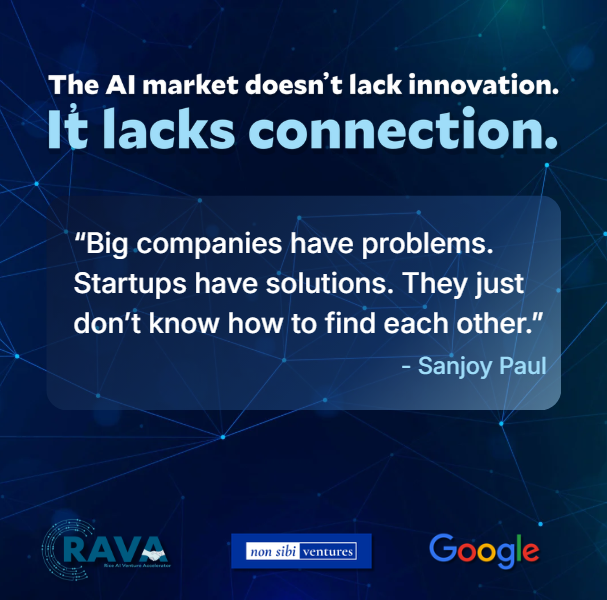
“Big companies have problems. Startups have solutions. But they don’t know how to find each other.” RAVA exists to bridge that divide.

A New Model for AI Commercialization
Looking ahead, Sanjoy believes the traditional model of corporate R&D will evolve toward a more open innovation framework—one where organizations collaborate with startups to solve complex challenges faster and more efficiently.

In many ways, RAVA represents the early stages of that transformation. By connecting enterprise demand, startup innovation, and academic research within a single ecosystem, the accelerator is building a model designed to move AI from concept to commercial impact.
And for Sanjoy, that mission is deeply aligned with his career-long focus: ensuring that powerful technologies don’t just remain ideas—but become tools that solve real-world problems.

Comments